
|
|
|
Monday, January 11, 2010
Top 40 Minnesota Twins: #33 Greg Gagne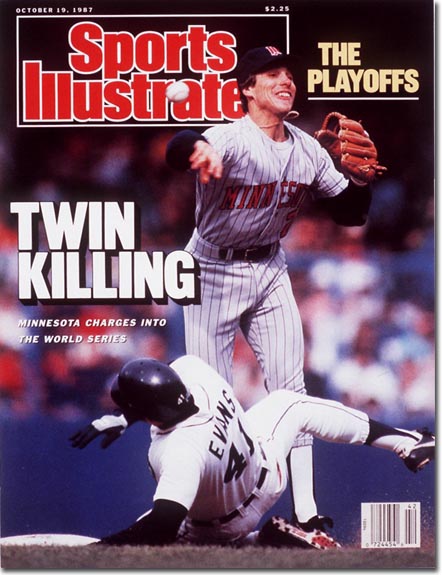 GREGORY CHRISTOPHER GAGNE | SS | 1983-1992 | CAREER STATS Gagne batted .255/.323/.462 with 17 homers in 119 games there as a 21-year-old and also got his first tastes of the big leagues with a brief stint in June as an injury replacement and a September call-up. He went just 3-for-27 (.111) and found himself at Triple-A again in 1984. Gagne put together another strong season there, hitting .280/.374/.441 with nine homers in 70 games, but didn't make it back to Minnesota until rosters expanded in September and merely sat on the bench once he got there. Tired of trotting out guys like Ron Washington, Houston Jimenez, and Lenny Faedo, the Twins turned to the 23-year-old Gagne as their starting shortstop in 1985. He hit just .225/.279/.317 with two homers in 114 games as a rookie and missed time with injuries in May and August. In his absence the Twins turned to Smalley, who had come back in a trade that offseason. Back problems forced Smalley to be a designated hitter in 1986 and the Twins went with Gagne on a full-time basis at shortstop. He came up with a solid sophomore campaign, hitting .250/.301/.398 with 12 homers in 156 games to rank 11th among all major-league shortstops in Value Over Replacement Player. In the second-to-last game of the season, Gagne hit inside-the-park homers in each of his first two at-bats against Chicago starter Floyd Bannister, and then smacked a triple off reliever Gene Nelson in his third at-bat to come 90 feet short of an all-time record. After committing an AL-worst 26 errors in 1986, Gagne had a team record 47-game errorless streak in 1987. He also hit .265/.310/.430 with 10 homers in 137 games as the Twins defeated the Tigers in the ALCS and beat the Cardinals in the World Series. Gagne hit just .229 in 12 postseason games, but had three homers and four doubles, drove in six runs, scored 10 times, and delivered a sixth-inning single that drove Tom Brunansky in as the go-ahead run in Game 7 of the World Series. Gagne had three fairly mediocre years from 1988-1990, and then hit .265/.310/.395 as the Twins once again won the World Series in 1991. This time Gagne hit just .195 in 12 postseason games and had just one homer, but it was a big one. With the Twins clinging to a 1-0 lead in the fifth inning of Game 1 against Atlanta, Gagne launched a three-run homer off Charlie Leibrandt that provided all the breathing room Jack Morris needed in a 5-2 win. Gagne became a free agent after batting .246/.280/.346 in 1992 and signed a three-year contract with Kansas City. He gave the Royals three solid years and then finished up his 15-year career with two seasons in the NL playing for the Dodgers. Gagne retired at 35 years old and was a starting shortstop in the major leagues from the moment the Twins handed him the job in 1985 to the moment he hung up the spikes in 1997, logging nearly 15,000 innings at the position. Researching these rankings has changed my opinion of Gagne's career more than any other Twins player. My only real memories of him in a Twins uniform were from 1991 and 1992, and my primary experience seeing him play came after he departed as a free agent. By that point Gagne was on the downside of his career and shortstops were starting to put up numbers that made his .249/.292/.385 line with the Twins look pathetic. However, take a closer look back at Gagne's decade in Minnesota and you'll discover a player who was more valuable than his paltry .677 OPS suggests. Perhaps the biggest key to seeing Gagne's value is in understanding the difference between baseball today and baseball in the 1980s. Not only is offense in general up significantly since then, players like Alex Rodriguez, Derek Jeter, Miguel Tejada, and Nomar Garciaparra revolutionized the way we look at shortstops. Meanwhile, during Gagne's time with the Twins the average shortstop hit a measly .252/.309/.346. For comparison, since 2000 the average MLB shortstop has hit .270/.325/.400. That may not seem like a huge difference, but it is. For overall offensive production, that's a gap of about 10 percent. If you take Gagne's career numbers with the Twins and add 10 percent to them, and you get something along the lines of .275/.320/.425. Jimmy Rollins is a career .274/.330/.439 hitter. He still doesn't exactly light up a stat sheet, but those adjusted numbers are a lot more palatable. And then you have his defense, which was excellent regardless of era. He never won a Gold Glove, as Alan Trammell and Tony Fernandez dominated the award in the 1980s, but Gagne is generally considered the best defensive shortstop in Twins history and Baseball Prospectus rates him as eight runs above average per 150 games in Minnesota (more advanced metrics aren't really available that far back). Despite the speed and athleticism that gave him range defensively Gagne was a horrible base-stealer. Historically bad, in fact. He was 79-for-134 (59 percent) for the Twins and no one else in team history with 50 steals is under 60 percent. And he was even worse after leaving, stealing 29 bags while being thrown out 41 times, including going 10-for-27 in 1994. Seriously. Overall he was 108-for-204, which at 53 percent is the second-worst rate ever among players who attempted 200 steals, behind Lou Gehrig. TOP 25 ALL-TIME MINNESOTA TWINS RANKS: Once you're done here, check out my NBCSports.com blog and Twitter updates.     
|

E-Mail: aarongleeman@gmail.com Twitter: twitter.com/aarongleeman  Read Me Elsewhere Rotoworld NBC Sports MinnPost Minnesota Twins Stuff Minneapolis Star Tribune St. Paul Pioneer Press MinnesotaTwins.com LaVelle E. Neal III Joe Christensen Kelsie Smith Kelly Thesier Seth Stohs Stick and Ball Guy Nick Nelson Parker Hageman Phil Mackey John Bonnes Edward Thoma Josh Johnson Howard Sinker Twinkie Town Pat Neshek Sports Stuff Hardball Talk Rotoworld Fan Graphs Baseball-Reference.com The Hardball Times Baseball America Baseball Think Factory Bill Simmons Rob Neyer Joe Posnanski Big League Stew The Big Lead Deadspin Fanhouse Baseball Prospectus U.S.S. Mariner Al's Ramblings Sports By Brooks Baseball Musings MLB Trade Rumors Non-Sports Stuff MinnPost Alan Sepinwall David Brauer Adam Carolla Poker Road Gorilla Mask Wicked Chops Poker WWTDD? Popoholic The Superficial Steve Silver Tao of Poker Discount Sporting Goods   ![[Powered by Blogger]](http://buttons.blogger.com/bloggerbutton1.gif)
 Official Fantasy Girl of AG.com OFGoAG.com Timeline: Heidi Klum (8/2002 - 12/2003) Jessica Alba (12/2003 - 10/2004) Elisha Cuthbert (10/2004 - 11/2006) Vacant (11/2006 - 6/2008) Keeley Hazell (6/2008 - 3/2010) Mila Kunis (3/2010 - Present) OFGoAG.com Candidates: Marisa Miller Jenna Fischer Kate Beckinsale Keeley Hazell Diora Baird Top 40 Twins Prospects of 2010: 1. Aaron Hicks, CF 2. Kyle Gibson, SP 3. Wilson Ramos, C 4. Miguel Angel Sano, SS 5. Ben Revere, CF 6. Angel Morales, CF 7. David Bromberg, SP 8. Danny Valencia, 3B 9. Matthew Bashore, SP 10. Billy Bullock, RP 11. Rene Tosoni, RF 12. Chris Parmelee, RF 13. Adrian Salcedo, SP 14. Joe Benson, CF 15. Jeff Manship, SP 16. Tyler Robertson, SP 17. Carlos Gutierrez, RP 18. B.J. Hermsen, SP 19. Anthony Slama, RP 20. Max Kepler, CF 21. Alex Burnett, RP 22. Robert Delaney, RP 23. Luke Hughes, 3B 24. Ben Tootle, RP 25. Deolis Guerra, SP 26. Shooter Hunt, SP 27. Trevor Plouffe, SS 28. Michael McCardell, SP 29. Reggie Williams, 2B 30. Estarlin De Los Santos, SS 31. Derek McCallum, 2B 32. Jose Morales, C 33. Chris Herrmann, LF 34. Bobby Lanigan, SP 35. Danny Rams, C 36. Josmil Pinto, C 37. Steven Tolleson, 2B 38. Anderson Hidalgo, 3B 39. Loek Van Mil, RP 40. Joe Testa, RP |